
Many AT&T customers across USA are asking the same question — can you negotiate your AT&T Fiber price or get them to match a competitor’s offer?
With Spectrum and other providers advertising aggressive introductory rates, customers are comparing options more than ever. But before switching or calling customer support, it’s worth understanding how AT&T Fiber pricing works — and how you can maximize your savings without compromising on reliability.
At BestISPDeals, we’ve reviewed customer experiences, pricing trends, and discount eligibility to help you make an informed choice.
1. Understanding AT&T Fiber Pricing
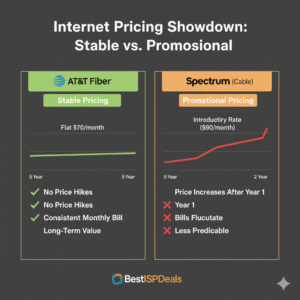
One customer shared their story on Reddit — they were paying $55/month for AT&T Fiber 300 Mbps after a $5 AutoPay discount. While Spectrum appeared to offer “special pricing” in their area ($40 for 500 Mbps or $50 for 1 Gbps), several replies revealed that Spectrum’s advertised prices often include limited-time promotions that increase significantly after the first year.
Meanwhile, AT&T Fiber’s pricing model is designed for stability and transparency:
- Consistent rates — No hidden fees or sudden hikes after 12 months
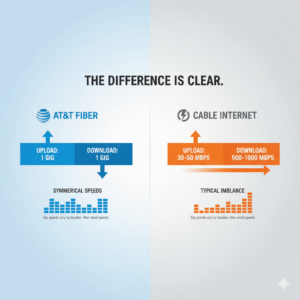
- Equal upload and download speeds — True fiber connection
- Reliable uptime — Less downtime compared to cable-based competitors
- AutoPay and bundle discounts — Up to $10/month savings
This means while competitors might look cheaper upfront, AT&T Fiber often delivers better long-term value.
2. Customer Experiences: The Price Debate
According to multiple Reddit users:
“You might want to check the actual speeds offered at your address… most Spectrum customers don’t have symmetrical speeds. I pay $80/month for AT&T Fiber 1 Gbps and it’s worth every penny.”
Others pointed out that Spectrum’s “fiber-like” service is still coaxial cable for most areas, meaning upload speeds are much lower than download speeds. In USA, Spectrum’s “fiber to the node” setup can’t match AT&T’s true fiber-to-home connection.
One user summarized it best:
“$55 a month for Fiber 300 isn’t bad at all. Add wireless service, and you can get up to 20% off — bringing it down to around $42.”
So while AT&T might not always match competitor pricing directly, they often provide better speeds, reliability, and bundled savings that even out the difference.
3. Can You Negotiate a Lower AT&T Rate?
Some customers have successfully secured discounts — especially when upgrading or bundling services. A few key strategies include:
✅ Bundle Services — Adding AT&T Wireless can unlock up to 20% off your Fiber bill.
✅ Use AutoPay — Save an additional $5–$10/month when paying through a checking account.
✅ Check for Targeted Offers — AT&T sometimes sends upgrade promotions (e.g., move from 500 Mbps to 1 Gbps for just $5 more + a $100 rewards card).
✅ Call the Retention Team — If you’ve been a long-time customer, politely ask about loyalty pricing or upgrade incentives.
However, as one user shared:
“I called to cancel my AT&T Fiber 1Gbps after a competitor offered me 10Gbps for $50/month. AT&T didn’t offer a discount, they just closed the account.”
That shows results vary — but trying is worth it, especially if you’re in a competitive fiber market like USA.

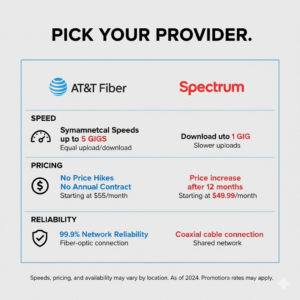
4. Comparing AT&T Fiber vs Spectrum in USA
When comparing internet options, remember that Spectrum’s low introductory rates are temporary. After 12 or 24 months, prices often increase sharply — unless you call to renegotiate.
AT&T Fiber, on the other hand, provides:
| Feature | AT&T Fiber | Spectrum |
|---|---|---|
| Connection Type | Fiber to Home | Coax (Cable) |
| Upload Speed | Equal to Download | Slower |
| Introductory Pricing | Stable | Temporary |
| Reliability | High | Variable |
| Average Cost (1 Gbps) | $80 | $70–$90 after promo |
| Hidden Fees | None | Often Added After Promo |
So while Spectrum may advertise “Fiber Internet,” most of its network is hybrid coax, meaning slower upload speeds and more frequent outages — especially during peak hours.
5. Why Reliability Matters More Than Price
Several customers emphasized reliability as the deciding factor:
“Spectrum has more outages and slower speeds during peak hours. AT&T Fiber stays consistent, even during storms.”
AT&T’s fiber infrastructure is built with redundancy and stable uptime — meaning fewer service interruptions. Especially in areas with challenging weather conditions, AT&T Fiber customers experience fewer disruptions compared to cable users.

Conclusion
If you’re trying to lower your internet bill in USA, the best strategy isn’t always switching providers — it’s maximizing discounts and ensuring long-term reliability.
AT&T Fiber may not always match promotional prices from competitors like Spectrum, but it consistently delivers:
- Transparent pricing
- True fiber speeds
- Reliable uptime
- Exclusive bundle savings
At BestISPDeals, we connect you directly with official AT&T offers — so you can explore available discounts, bundle options, and loyalty deals safely and confidently.