
It’s a question many internet users in USA face: Should I stay with AT&T or return to Spectrum?
A recent customer story highlights this exact struggle. After facing a price hike and repeated service outages with Spectrum, the user decided to switch to AT&T for a seemingly better deal. But soon after installation, Spectrum countered with an even better offer — leaving them unsure which provider truly made sense long-term.
Let’s break down this real-life scenario and what it teaches us about choosing between AT&T and Spectrum in USA.
1. The Real-World Situation: AT&T vs Spectrum
The user’s initial problem started when their Spectrum bill jumped from $65 to $80/month for a 200 Mbps plan — and Spectrum support wouldn’t lower the price.
Frustrated, they switched to AT&T, signing up for 75 Mbps at $60/month. The installation went smoothly. But when they called Spectrum to cancel, the company offered a 500 Mbps plan for $40/month — valid for two years.
Now the customer had two active services:
- AT&T: $60/month, 75 Mbps (Copper-based DSL)
- Spectrum: $40/month, 500 Mbps (Cable)
That led to the big question: Is it worth staying with AT&T, or should I go back to Spectrum?
 2. Comparing Internet Technology: Fiber vs Copper vs Cable
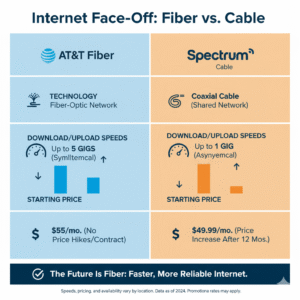
The first thing to understand is that AT&T offers two types of internet:
- AT&T Fiber (ultra-fast, reliable, modern connection)
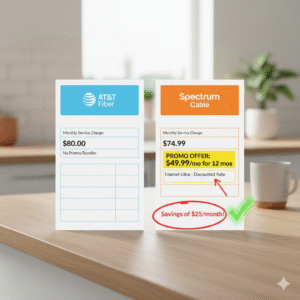
- AT&T Internet (DSL or copper) — slower and being phased out in many areas
In this case, the user’s new AT&T plan was copper-based, not fiber. That means the 75 Mbps cap is a limitation of the older network infrastructure.
Meanwhile, Spectrum runs on coaxial cable, which supports much faster download speeds — up to 500 Mbps or even 1 Gbps in some USA neighborhoods.
So while AT&T Fiber can outperform Spectrum easily, AT&T’s copper DSL usually can’t compete in speed or reliability.
3. Price Breakdown and Promotional Offers
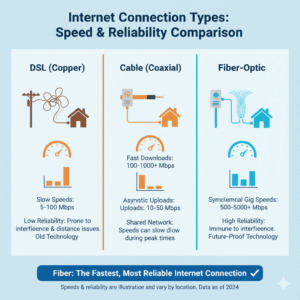
Here’s a simplified price comparison from the customer’s case:
| Provider | Plan Type | Speed | Monthly Cost | Notes |
|---|---|---|---|---|
| AT&T (DSL) | Copper | 75 Mbps | $60 | Installed, no fiber available |
| Spectrum (Cable) | Coaxial | 200 Mbps | $80 → offered $40 | Two-year promo |
Spectrum’s last-minute offer — 500 Mbps for $40/month — is a far better value than AT&T’s 75 Mbps for $60. However, promotional rates are temporary, typically lasting 12–24 months.
After that, rates may increase again — and the cycle of switching and negotiating begins anew.
4. Reliability and Customer Experience
Spectrum has had its share of outages — as the user mentioned, two service interruptions in one month. However, many commenters noted that AT&T’s DSL service can also struggle with consistency, particularly as AT&T phases out older copper lines.
Customer experiences from the thread show mixed opinions:
- Some users recommend staying with Spectrum until fiber becomes available in USA.
- Others warn that AT&T’s DSL service may not perform well for remote work or smart home setups.
- A few suggested contacting AT&T again to negotiate a better offer or check if fiber is available soon.
In general, fiber > cable > DSL, both in speed and long-term reliability.

5. Contract Terms and Exit Options
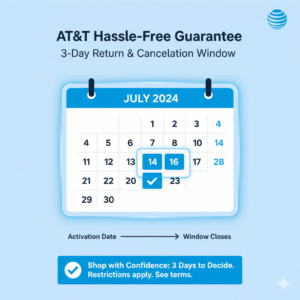
One key detail in this story is timing. If you’ve recently installed AT&T service and changed your mind, you typically have a 3-day cancellation window to back out without penalty.
Several commenters advised the same — cancel quickly if you’re unsatisfied. AT&T’s DSL contracts can lock you in for 12 months, with early termination fees ranging from $180 to $360, depending on the plan.
Spectrum, on the other hand, often runs no-contract promotions, giving you more flexibility to cancel or renegotiate when your rate changes.
6. What’s the Smarter Move for USA Residents?
For USA customers in a similar situation, here’s what to consider before deciding:
✅ Check AT&T Fiber availability – If fiber is available, it’s absolutely worth switching.
✅ Compare real speeds vs advertised – DSL may not sustain consistent speeds during high usage.
✅ Negotiate before canceling – Spectrum often matches or beats competitors’ rates when they know you’re leaving.
✅ Avoid long-term contracts – Flexibility matters as new fiber networks roll out across USA.
If AT&T Fiber isn’t available yet, Spectrum’s cable internet likely provides the best mix of speed, price, and reliability for now.
Conclusion
In this real-world case, switching to AT&T DSL didn’t offer better value or performance — especially after Spectrum countered with a superior offer.
The takeaway? Always compare both technology types (fiber, cable, DSL) and total cost after promos before switching providers.
At BestISPDeals, we help USA customers evaluate AT&T, Spectrum, and other internet providers side-by-side to ensure you get the best speed, price, and reliability — without the guesswork.