
For business owners in USA, reliable internet is the foundation of daily operations—especially when managing multiple tenants, office floors, or coworking spaces. But when faced with a choice between Spectrum Enterprise’s 500Mbps dedicated fiber at $600/month and AT&T Business Fiber’s 1Gb shared line at less than $200/month, the question becomes: is the savings worth the trade-off?
At BestISPDeals, we’ve analyzed this exact dilemma shared by a business owner managing the internet for an entire office building. Let’s explore how Spectrum’s dedicated service compares to AT&T’s business fiber, what you gain and what you risk, and how to make a smart, balanced decision.
1. Dedicated vs Shared: Understanding the Real Difference
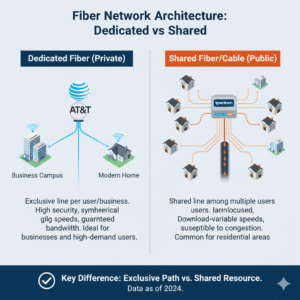
The first major difference between Spectrum’s 500Mbps dedicated fiber and AT&T’s 1Gb business fiber lies in how bandwidth is delivered.
- Spectrum Enterprise Fiber (Dedicated Internet Access): You get a private line with guaranteed speed and uptime. This includes a Service Level Agreement (SLA) with compensation for downtime, proactive monitoring, and priority repair times.
- AT&T Business Fiber (Shared Network): While you can get higher speeds at a lower cost, the connection is shared with other users in the area. That means potential slowdowns during peak times and no SLA guaranteeing performance or response time.
For many small offices and coworking environments with moderate usage (like browsing, email, and video calls), shared business fiber performs just fine. However, if you rely on guaranteed uptime or host critical services, a dedicated circuit might still hold value.
2. Performance Analysis: Real Usage vs Theoretical Speed
In the shared case study, the building owner reported:
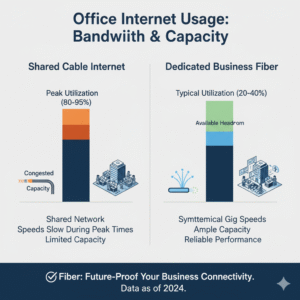
- Peak utilization: 42% of the 500Mbps circuit
- Average top 1% usage: 12%
- Overall average: 1.2%
Even with 60 potential users and 15–20 active connections during business hours, the existing dedicated 500Mbps line was underutilized. This means the actual bandwidth demand was low, suggesting that even a shared 1Gb AT&T connection could easily handle the load.
For standard office work and light VoIP usage, AT&T’s shared 1Gbps fiber is more than sufficient—especially when you factor in the cost difference.
3. Cost Efficiency and Redundancy: Two for the Price of One
One of the most compelling arguments for switching is cost savings. At $600/month for Spectrum versus under $200 for AT&T, the difference is significant enough to add a backup connection and still pay less.
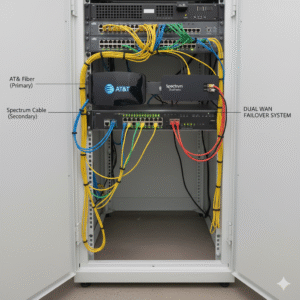
Many enterprise clients are now replacing single expensive circuits with dual broadband connections for redundancy:
- Primary: AT&T 1Gb Business Fiber
- Secondary (Backup): Spectrum or another ISP (even 5G or Starlink)
This approach, often called ISP redundancy or provider affinity, ensures uptime even if one provider experiences an outage. For many businesses, this hybrid setup offers better reliability than a single dedicated circuit.
4. Service Level Agreements (SLAs) and Real-World Reliability
Spectrum’s enterprise service comes with SLA-backed guarantees—uptime, latency, and response time commitments. AT&T’s business fiber, on the other hand, does not include such strict guarantees.
However, in real-world use, AT&T’s business fiber has proven stable and consistent across most markets. For small businesses, the SLA often translates into credits for downtime rather than actual speed or reliability advantages.
As one IT professional commented in the thread:
“The SLA on an enterprise circuit still doesn’t buy you anything other than some credits. It doesn’t mean the service will be better or that repair times are guaranteed.”
For most offices in USA, uptime and reliability on AT&T’s shared fiber are comparable to dedicated service—making it a practical choice for non-critical environments.
5. Technical Considerations and Installation Tips
Before switching, keep in mind:
- Symmetrical Speeds: Both Spectrum and AT&T offer equal upload and download speeds on business fiber.
- Installation Time: Dedicated circuits often take months (due to new fiber trenching), while AT&T business installs are typically completed in under 30 days.
- Network Separation: Even with different ISPs, fiber routes may share the same poles or underground paths—so true path diversity can be limited.
- Equipment: Spectrum provides enterprise-grade routers; AT&T’s gear is simpler but sufficient for most small networks.
Pro Tip: Start your AT&T installation before your Spectrum contract ends. This gives you time to test stability, monitor performance, and transition without service gaps.
6. Expert Insights: Balancing Cost, Risk, and Convenience
Industry professionals generally agree on these points:
- For heavy enterprise use with strict uptime requirements → Stay with dedicated (Spectrum).
- For light to moderate office usage with a focus on cost savings → Go with AT&T business fiber (shared).
- For best reliability → Use AT&T as primary + another ISP as backup.
Many businesses have already transitioned from costly DIA circuits to broadband-based fiber without issues—achieving the same reliability at a fraction of the cost.
Conclusion: The Smart Choice for USA Businesses
If your office or coworking space in USA averages low utilization, switching from Spectrum’s 500Mbps dedicated fiber to AT&T’s 1Gb business fiber can be a smart financial move.
By combining AT&T’s affordable high-speed service with a backup connection, you can achieve both reliability and cost-efficiency—without sacrificing performance for your tenants.
At BestISPDeals, we help USA business owners find the perfect internet setup that balances speed, reliability, and savings.